


AI Means Continuous Learning


Continuous Learning in AI Applications: The Key to Maintaining a Competitive HR Edge
In the year 2025, the nature of work and talent management has transformed significantly. Human Resources (HR) departments, once primarily concerned with administrating benefits and compliance, now sit at the strategic center of organizations. The unprecedented growth of artificial intelligence (AI) technologies, propelled by advanced machine learning models, data analytics, and natural language processing, has shifted how HR professionals source talent, assess performance, and guide career development. In this evolving landscape, the ability of AI applications to continuously learn and improve is no longer a luxury—it's a necessity. Without embracing continuous learning, HR departments risk losing their competitive edge, struggling to attract, retain, and develop top talent in an increasingly globalized and dynamic labor market.
The Emerging Context: Why Continuous Learning in AI Is Crucial
The HR ecosystem in 2025 is profoundly data-driven. Recruitment platforms leverage sophisticated AI algorithms to sift through massive candidate pools, matching skill sets, cultural fit, and even personality traits to job descriptions. Performance management tools use real-time data to forecast future skill gaps, while sentiment analysis monitors employee well-being and engagement. All these systems rely on AI to deliver insights and recommendations that would have been impossible to generate at scale a mere few years earlier.
However, the environment is not static. Skills in demand today may lose their relevance within months; new roles emerge as technology and market trends shift. Consider a multinational technology firm that decides to invest heavily in quantum computing services. Within six months, the previously niche field becomes a core part of the organization’s strategy, requiring a quick pivot in hiring, training, and retention initiatives. An AI-driven HR system that does not continuously learn would be left referencing outdated job skill frameworks, highlighting talent pools that no longer match the firm’s needs, and making compensation recommendations based on legacy market data. In other words, without continuous learning, the AI-driven HR function becomes a static snapshot in a world that requires a dynamic film reel.
A Practical Example: Adaptive Skills Mapping
Imagine an AI-driven talent mapping tool that identifies skill sets within the workforce and correlates them with emerging business needs. Initially, the tool is trained on a snapshot of internal data—employee performance metrics, educational backgrounds, and past project outcomes—and external market data—industry standards, salary benchmarks, and skill shortages. At first, it works well. It identifies that the company needs more data scientists proficient in natural language processing to handle the organization’s push into new voice-enabled customer service offerings.
But three months later, the market changes. Customers begin demanding immersive virtual environments as part of their product experience. Suddenly, the need shifts: the organization urgently requires engineers and product managers familiar with augmented reality (AR) and extended reality (XR) frameworks. A static AI system would continue churning out recommendations that focus on data science for NLP, failing to catch the sudden surge in AR/XR demand. Only a continuously learning AI application—one that updates its data sources daily, incorporates new market trends from real-time analytics, and refines its predictive models—can quickly pivot to identify AR/XR talent gaps. In this example, continuous learning ensures the system remains relevant, guiding HR Directors toward timely and strategic talent decisions.
Decisions HR Directors Face
1. Budget Allocation for AI Upgrades: HR Directors must decide how much of their limited budget to allocate toward continuous learning capabilities. Implementing machine learning pipelines that re-train models, integrating new data sources, and investing in scalable cloud infrastructure can be expensive. They must weigh the short-term cost against the long-term strategic benefit. Failing to fund continuous learning risks stagnant systems that become less effective over time, while investing too heavily in cutting-edge retraining mechanisms might reduce the budget for other essential HR initiatives.
2. Data Ethics and Compliance: Ensuring the AI’s continuous learning does not violate privacy, compliance, or ethical standards is paramount. HR Directors must decide which data streams are permissible, how to keep sensitive employee data protected, and how to maintain transparency. Incorporating continuous learning may require collecting and integrating data from various sources—social media trends, industry benchmarks, new training module completion rates. Each data source raises questions: Are these data points legally and ethically collectible? How to ensure the AI’s evolving recommendations do not introduce bias? Directors must strike a balance between richer data sets and maintaining trust and integrity.
3. Integration with Overall Corporate Strategy: HR Directors must ensure that the continuously learning AI is integrated tightly with the organization’s strategic roadmap. They need to decide how often to recalibrate skill taxonomies and how dynamically the HR strategy should respond to insights from the AI. Do they let the AI’s evolving recommendations directly influence hiring targets and learning & development (L&D) initiatives? Or do they introduce manual review steps, which could slow responsiveness but provide more human oversight?
Requirements Managers Will Face—and Their Responses
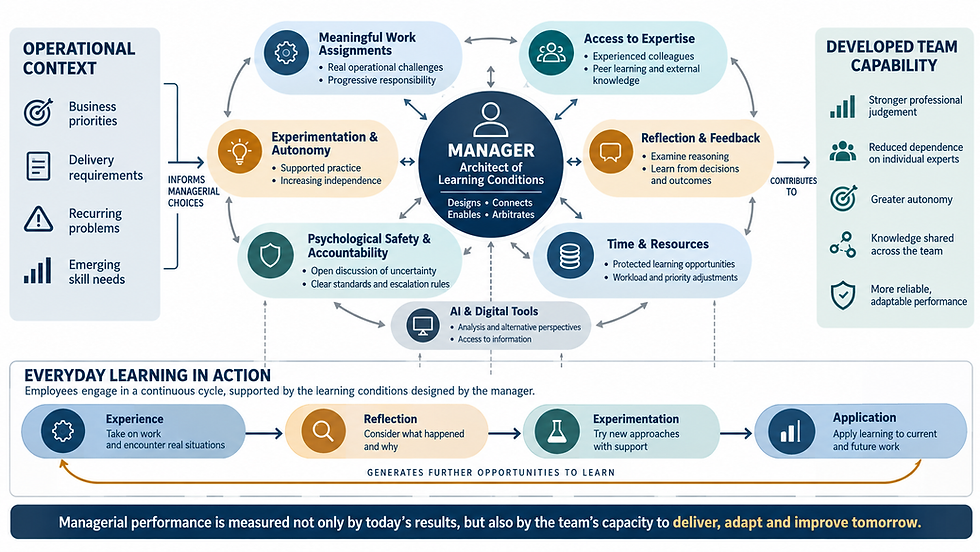
1. Ongoing Skill Upgrading for Managers: First-level and mid-level managers will need to develop the ability to interpret AI-driven insights. These insights will be more dynamic and potentially more complex than anything they’ve dealt with before. Managers who previously relied on stable performance metrics will now face a constantly changing landscape of skill requirements, predicted performance outcomes, and dynamic succession planning scenarios.
Possible Answer: A manager might invest time in L&D modules specifically designed to enhance data literacy. They’ll learn how to read AI-generated dashboards, understand confidence intervals, and appreciate the difference between correlation and causation in predictive recommendations.
Consequence: Managers who proactively build these skills will be able to leverage AI insights effectively, guiding their teams more strategically. Those who don’t risk feeling overwhelmed and making suboptimal decisions, potentially missing out on new opportunities to improve team performance.
2. Adjusting Team Structures and Responsibilities: As AI-driven insights highlight emerging skill needs and highlight redundancies, managers may have to reorganize teams quickly. For instance, if the AI shows that a marketing team’s skill in user interface (UI) design is becoming less critical compared to user experience (UX) research, managers may need to shift responsibilities, retrain certain employees, or hire new talent.
Possible Answer: Managers could develop flexible team structures, creating agile pods that can be reconfigured based on AI-driven insights. They could also establish rotation programs that encourage employees to diversify their skills, making reassignments smoother when a sudden skill shortage emerges.
Consequence: By embracing fluid team structures and skill rotation, managers ensure resilience and adaptability. If they resist, relying on static job roles and siloed teams, they risk being unprepared for sudden shifts in strategic direction. Over time, this rigidity will degrade competitive performance and employee morale.
3. Embracing Continuous Feedback and Performance Reviews: AI systems that continuously learn can update performance metrics and identify coaching needs in near real-time. Managers will face new requirements to adopt continuous feedback loops rather than relying on annual reviews.
Possible Answer: Managers can introduce weekly or monthly coaching sessions supported by AI-driven analytics. For instance, if a team member’s work quality dips immediately after adopting a new software tool, the AI may flag this issue, and the manager can step in promptly to provide support or training.
Consequence: Embracing continuous feedback creates a more engaged workforce that responds rapidly to performance issues and opportunities for improvement. If managers cling to old patterns—waiting a year to address performance dips—they may find that top talent grows disengaged, productivity suffers, and the organization loses its edge in a rapidly changing market.
4. Cultivating a Culture of Data-Driven Decision-Making: Managers must now integrate AI insights into everyday decision-making processes. This could mean using data to identify high-potential employees for mentorship programs, pinpointing emerging external skill sets to inform internal training, or aligning employee satisfaction scores with productivity metrics.
Possible Answer: Managers can set regular briefings where AI-driven reports are reviewed and actions are formulated. They can also encourage team members to propose data-backed ideas, thus democratizing the analytics-driven culture.
Consequence: By fostering a data-literate workforce that trusts and understands AI recommendations, managers will ensure that insights lead to meaningful actions. If managers fail to adapt, teams remain skeptical and revert to gut-instinct decisions, missing out on the nuance and speed that continuously learning AI can deliver.
Conclusion: Winning with Adaptability
The 2025 talent landscape demands HR and management practices that are agile, informed, and forward-looking. Continuous learning in AI applications is not simply about having a cutting-edge tool—it’s about creating an environment where technology constantly refines its understanding of the workforce and the market, providing actionable insights that guide strategic talent decisions.
HR Directors face tough calls on budget allocation, ethics, and strategic integration of these advanced systems. Managers, from the frontline to the mid-tier, must evolve their skill sets, embrace dynamic team structures, and develop a comfort with continuous performance feedback. By doing so, they enable their organizations to pivot quickly, exploiting new market opportunities and rectifying talent gaps before they become critical liabilities.
Without continuous learning, AI-driven HR tools become relics trapped in time— snapshots of a world that no longer exists. With continuous learning, organizations keep a competitive edge, consistently adapting and thriving as the talent landscape shifts beneath their feet. In the complex and fast-paced environment of 2025, continuous learning in AI is not just a technical requirement—it’s the strategic differentiator that separates the winners from those left behind.


Comments