


The Manager as an Architect of learning conditions

The deadline is approaching, the requirements are incomplete, and everyone knows who will fix the problem. The department’s most experienced specialist steps in, clarifies the brief and gets delivery back on track. The manager thanks him/her. A few weeks later, the same situation occurs again. Meanwhile, colleagues have attended training, gained experience and started using AI to prepare their analyses. Their outputs look more polished. Yet unfamiliar situations still lead them back to the same expert.
This illustrative situation raises a question for middle managers and department directors: why does an active, trained team remain dependent on a few people? One explanation lies in the gap between doing work and learning from it. Experience provides material for learning, but someone must help organise the conditions that turn it into greater capability. That responsibility places the manager at the centre of the learning ecosystem.
What everyday learning actually changes
Learning at work becomes meaningful when employees can interpret a situation more accurately, make a better decision or handle a difficulty they previously needed help to resolve. It develops through formal education, observation, practice, feedback and conversations with others. Its value appears in what people subsequently do. In the project team, rescuing each incomplete brief protects immediate delivery. However, unless colleagues understand how the specialist identifies missing information and resolves ambiguity, the intervention leaves their capability largely unchanged. They experience another project without necessarily becoming better equipped for the next one.
AI makes this distinction more consequential. A colleague can now generate a convincing requirements document quickly, while remaining uncertain about which questions matter or which assumptions need checking. Equally, comparing an AI proposal with an expert’s reasoning can help them understand those issues. The learning outcome depends on how the tool is used within the work. Research by Erik Brynjolfsson, Danielle Li and Lindsey Raymond (1), published in 2025, found evidence of learning benefits from an AI assistant in customer support. A separate survey by Hao-Ping Lee and colleagues (2) associated greater confidence in generative AI with less reported critical thinking. These studies address different contexts and do not establish a universal outcome. Together, they support examining understanding alongside assisted performance. For the manager, the practical question is whether a stronger output also reflects a stronger ability to explain, verify and adapt it.
Why the manager occupies a central position
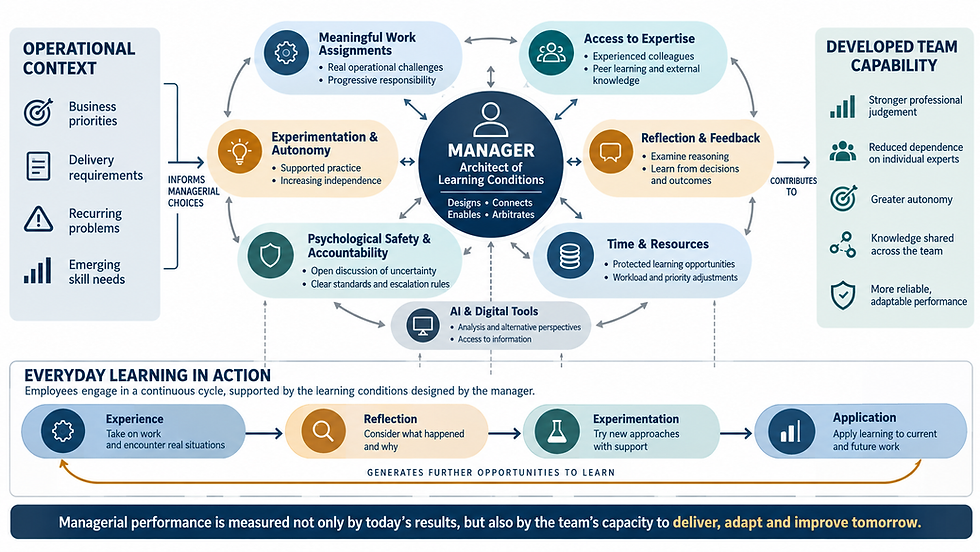
A learning ecosystem comprises people, resources, relationships and practices through which employees develop capability. It includes trainers, colleagues, professional communities, documentation and digital tools. Access to these elements matters, but their connection to actual work determines much of their usefulness. The manager works at the junction of the results required, the assignments employees receive and the support available to complete them. A trainer can introduce a method. A colleague can explain how they use it. Within their authority, the manager can assign a suitable task, adjust competing priorities and create an opportunity to apply it.
This is what gives the architect metaphor its substance. Coaching supports an employee’s reflection; teaching explains something they need to understand. Building learning conditions includes deciding how work, time, expertise and feedback will fit together. The manager shares this responsibility with employees, peers and learning specialists. They cannot control another person’s learning. They can, however, influence whether curiosity has somewhere to go, whether advice can be tested and whether emerging competence receives progressively greater responsibility.
From repeated rescue to deliberate development
Returning to the project team, the manager could begin with a brief review of the latest requirements problem. Instead of accepting “the brief was incomplete” as the explanation, they ask the specialist to reconstruct their reasoning. Which uncertainties did they notice? What did they ask the client? How did they distinguish essential information from details that could wait?
Colleagues then compare this approach with their own. Perhaps they assumed that requesting clarification would delay delivery, although proceeding with ambiguous requirements created more rework later.
The discussion identifies a change to test: involving the client earlier and clarifying key assumptions before drafting the full specification. This goes beyond improving a document. It challenges the team’s understanding of what an efficient handover requires.
For the next project, the manager gives a less experienced colleague responsibility for the initial clarification, with the specialist available at an agreed checkpoint. The learning objective is explicit: identify consequential uncertainties and explain how they were resolved. The operational objective remains a usable brief delivered on time.
An approved AI tool can help propose questions or structure the document. The colleague must still explain which suggestions they retained, what they rejected and what the client’s answers changed. AI becomes part of the learning situation because its contribution is examined against evidence and professional judgement.
Connecting expertise without creating new dependence
The specialist’s involvement needs careful design. If they take over whenever uncertainty appears, the team recreates its original dependence. If they withdraw too quickly, the colleague faces a challenge without adequate support.
The manager therefore arranges a gradual transfer: observation, supported action, feedback and increasing autonomy. Subsequent assignments provide opportunities to reuse the reasoning in different circumstances. Capability becomes more credible when the employee can adapt what they learned to a new case.
Knowledge must also travel beyond this pair. A short case discussion can explain why the team changed its approach, where the new practice helps and where it may be insufficient. Recording those distinctions makes the experience useful to others without turning one successful solution into an unquestionable rule.
Department directors have a further role in connecting teams. Another unit may already handle similar handovers effectively. Professional communities may offer approaches unfamiliar to the department. Managers can enable those exchanges and help practitioners test their relevance.
The ecosystem grows through this movement between external ideas, shared examination and practical application. Its strength lies in people being able to find and use expertise, rather than continually returning to one indispensable individual.
Learning conditions requires managerial choices
The obvious objection is time. A manager facing tight deadlines and limited staffing may reasonably ask how development can fit alongside delivery.
The answer involves real trade-offs. Supported assignments can initially take longer. Experts need time to explain their reasoning. Reflection occupies attention that could otherwise go towards another task. Learning cannot depend indefinitely on employees absorbing these costs in addition to a full workload.
The manager needs to choose where the investment is justified. A recurring problem, a fragile concentration of expertise or an emerging responsibility provides a stronger starting point than a general ambition to make every activity educational. In the project example, repeated rework gives the investment an operational rationale.
Some choices fall within the manager’s authority: pairing colleagues, protecting a short review or redistributing an assignment. Others require a director’s decision, such as reducing commitments or securing support across departments. Building learning conditions includes making those requirements explicit.
It also involves creating a climate where uncertainty can be discussed. Amy Edmondson’s research found an association between psychological safety and team learning behaviour (3). A manager’s response to questions and reported difficulties helps establish whether employees will reveal what needs attention.
Clear standards remain necessary. The supported assignment needs boundaries, checkpoints and escalation criteria. Employees can explore and learn while remaining accountable for the decisions they make.
The manager whose contribution becomes less visible
As the team improves, the specialist intervenes less often. More colleagues can clarify ambiguous requirements, explain their reasoning and identify when help is needed. The manager has strengthened the department’s capacity to deliver.
Yet this contribution may receive less recognition than the earlier rescues.
Where appraisal concentrates on immediate results, the dramatic intervention is easy to see. The manager who prevents recurring dependence leaves a quieter trace: fewer escalations, broader competence and problems handled before they become crises. Those benefits emerge over time and involve several contributors.
The paradox is that an organisation can praise employee development while rewarding managerial behaviour that preserves dependence. A manager repeatedly solving difficult problems may appear more valuable than one whose team has learned to solve them.
Annual appraisal should therefore examine both results and the capability developed to sustain them. In the project case, useful evidence would include more employees handling clarification, less avoidable rework and sound decisions made with less specialist intervention. Such evidence requires context; no single indicator establishes the manager’s contribution.
Conversations throughout the year can connect managerial choices with observed progress. Counting training attendance or debriefs is insufficient. What matters is whether these activities have changed what the team can reliably do.
We need a broader definition of managerial performance
As AI becomes part of everyday work, organisations will need to assess the human capability developing around it. More impressive outputs alone cannot establish whether employees understand the work more deeply or are becoming better able to manage unfamiliar situations.
Recognising managers as architects of learning conditions would give this responsibility a clearer place in workload decisions, management development and performance reviews. Department directors would need to support the necessary trade-offs and equip managers to design assignments, facilitate reflection and assess growing autonomy.
A practical starting point remains modest: choose one recurring difficulty, examine the reasoning behind it and organise a supported opportunity to act differently.
The decisive change is in what the organisation values. A manager’s performance includes the results achieved today and the capacity their team develops to reproduce, adapt and improve those results tomorrow.
(1) Brynjolfsson, Erik, Danielle Li et Lindsey Raymond (2025). “Generative AI at Work.” The Quarterly Journal of Economics, vol. 140, n° 2, mai 2025, p. 889–942.
(2) Lee, Hao-Ping, Advait Sarkar, Lev Tankelevitch, Ian Drosos, Sean Rintel, Richard Banks et Nicholas Wilson (2025). “The Impact of Generative AI on Critical Thinking: Self-Reported Reductions in Cognitive Effort and Confidence Effects From a Survey of Knowledge Workers.”
(3) Edmondson, Amy C. (1999). “Psychological Safety and Learning Behavior in Work Teams.” Administrative Science Quarterly, vol. 44, n° 2, juin 1999, p. 350–383.


Comments