


How Individual Expertise Becomes Collective Capability


When Expertise Becomes a Bottleneck
Consider an engineering company employing highly qualified professionals. Its specialists are respected, experienced and technically proficient. They solve complex problems, understand customer requirements and frequently deliver results that less experienced colleagues would struggle to achieve. Yet the organization faces a persistent difficulty. Whenever an unusual technical problem arises, everyone turns to the same two or three experts. Projects slow down when they are unavailable. Different teams repeatedly encounter similar difficulties, without benefiting from solutions developed elsewhere. Newly recruited employees require extensive supervision, even when procedures and documentation are readily available. The company's problem is not a shortage of expertise. It is its inability to turn expertise into a capability shared by the organization.
A project manager decides to address the situation by introducing regular knowledge-sharing meetings. Experts present challenging cases and explain how they solved them. Presentations are stored in a common repository. Participation is encouraged. Six months later, employees know more about one another's activities. However, the underlying dependency remains. When a difficult decision must be made, the same experts are still called upon.
What went wrong? The initiative made information more accessible, but it did not fundamentally change how people worked, reasoned or made decisions together. This distinction is central to understanding how individual expertise becomes collective capability.
Knowledge Sharing Is Necessary, but Not Sufficient
Organizations tend to regard expertise as an individual attribute. People acquire knowledge, develop skills, accumulate experience and progressively become proficient in their respective domains. Human resource systems largely reinforce this perspective. Recruitment identifies individual competencies. Training develops individual skills. Performance reviews assess individual contributions. Career structures recognize professional specialization. None of these practices is inherently problematic. Organizations depend on individual expertise. However, the existence of competent individuals does not establish the existence of a competent collective. A team can contain outstanding professionals and still struggle to coordinate decisions, respond to unfamiliar situations or solve problems that cross functional boundaries.
One reason is that expertise involves much more than possessing information. Experienced professionals recognize patterns, distinguish important signals from irrelevant details and anticipate consequences. They know when established procedures apply and when circumstances require a different approach. Much of this knowledge is tacit. It is embedded in experience and professional judgment rather than fully articulated in documents. Michael Polanyi's (1) work on tacit knowledge helps explain why professional expertise cannot always be reduced to explicit instructions. An experienced engineer may immediately suspect the cause of an equipment failure without being able to describe every step in the reasoning. A senior consultant may recognize an organizational problem before collecting all the evidence needed to explain it. Simply asking such professionals to share their knowledge does not necessarily make their judgment available to others. The challenge is therefore not only to transfer information, but to make professional reasoning sufficiently visible for others to question, understand and progressively use it.
There is another difficulty. Even when team members understand one another's expertise, they may remain unable to combine their contributions effectively. The quality of a collective response depends on how people coordinate their work, interpret situations, handle disagreements and adjust decisions as circumstances change. Collective capability emerges through repeated, organized interactions—not merely through access to individual knowledge.
Four Mechanisms That Transform Expertise into Collective capability
Four interdependent mechanisms explain how this transformation can occur.
Make expert reasoning visible. When experts explain their decisions, they often begin with the solution. Yet the real learning opportunity lies in understanding how they reached it. What information did they consider decisive? Which alternatives did they reject? What assumptions influenced their judgment? Under what circumstances would they choose differently? These questions help others reconstruct the reasoning behind a professional decision. The objective is not to turn every expert into a trainer or require exhaustive explanations of routine activities. It is to identify situations in which making judgment explicit will improve the team's future ability to act. This is particularly valuable when a decision involves uncertainty, exceptions or competing objectives.
Confront different perspectives around actual work. Expertise becomes collectively valuable when different professional perspectives interact. Consider a product-development team bringing together engineering, marketing, operations and customer support. Each function holds information that the others may overlook. Engineers understand technical feasibility. Marketing interprets customer expectations. Operations anticipates production constraints. Customer support identifies recurring problems in actual use. Their contributions do not automatically combine into a sound decision. They must examine their respective assumptions, clarify disagreements and construct an interpretation that takes account of the whole situation. Karl Weick and Karlene Roberts, in their research on heedful interrelating, demonstrated the importance of people understanding how their individual contributions connect to the actions of others. The implication is significant: effective teamwork requires more than coordinating separate tasks. People must understand how their actions affect the collective undertaking.
Convert experience into shared operating practices. A successful intervention does not, by itself, create organizational learning. Suppose a project team resolves a difficult customer problem. The immediate objective has been achieved, but what has changed in the team's ability to handle the next problem? Collective learning requires examining the experience. Which decisions proved effective? Which assumptions were incorrect? What should be repeated, modified or abandoned? Such reflection may lead to improved decision rules, clearer interfaces between functions, new escalation criteria or revised working methods. These improvements constitute a form of collective memory. However, documenting them is only an intermediate step. Their value must be tested when the team encounters another situation. A procedure that nobody uses is not evidence of collective capability.
Reinforce capability through repeated application. An organization cannot establish collective capability through a single workshop or knowledge-sharing session. People must repeatedly apply what they have learned, observe results and adjust their behavior. This process gradually changes the distribution of competence within the team. Less experienced employees become capable of handling situations that previously required expert intervention. Specialists develop a better understanding of adjacent functions. Decisions become less dependent on particular individuals. Importantly, collective capability does not require everyone to become equally competent in every field. Specialization remains necessary. What changes is the team's ability to combine specialized knowledge, coordinate judgment and respond effectively when established routines prove inadequate.
What Managers and HR Can Do Differently
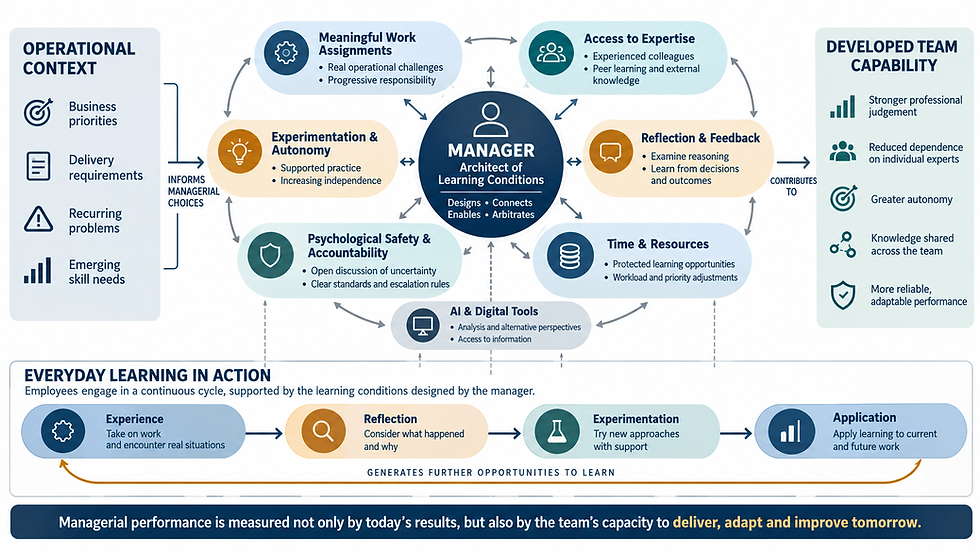
For middle managers, the practical challenge is to integrate these mechanisms into operational work without creating another layer of meetings and administrative procedures. Five interventions deserve particular attention.
First, identify critical dependencies. Examine the situations in which work stops because a particular person is unavailable. Who holds knowledge that others repeatedly need? Which decisions cannot be made without a specific expert? Where do teams repeatedly solve problems already encountered elsewhere? These dependencies reveal where individual expertise has not yet become a collective resource.
Second, design assignments that create learning opportunities.
Instead of systematically allocating complex problems to the most experienced specialist, involve a less experienced colleague in the analysis and decision process. The expert retains responsibility for decisions requiring their judgment, while making the reasoning visible. Over time, responsibility can be progressively transferred. The objective is not to sacrifice operational performance for learning, but to make learning part of performance.
Third, use operational reviews to examine reasoning, not merely results.
Many project reviews concentrate on deadlines, deliverables and deviations from plans. Managers can introduce a different set of questions:
• What did we initially believe?
• What did experience reveal?
• Which decisions would we make differently?
• What should other colleagues now be able to do?
These questions turn routine discussions into opportunities for collective learning.
Fourth, change what is recognized and rewarded.
If experts are rewarded exclusively for their individual contributions, organizations should not be surprised when knowledge remains concentrated. Recognition should also reflect contributions to others' development, improved coordination and reduced operational dependencies. This is where HR has an important role. Competency frameworks, performance reviews and career pathways can recognize the ability to strengthen the collective without requiring experts to abandon their professional identity or become hierarchical managers.
Fifth, evaluate capability through observable changes in work.
The number of knowledge-sharing sessions, documents produced or employees trained provides limited evidence of progress. More meaningful indicators include whether teams can solve recurring problems with less expert intervention, integrate newcomers more effectively, manage cross-functional decisions and adapt established practices to unfamiliar situations. These indicators are contextual rather than universal. They should be selected according to the team's actual responsibilities and operating environment. Ultimately, the central question is not how much knowledge has been shared, but what the team can now accomplish that it could not accomplish before.
The Real Asset Is What People Can Do Together
Individual expertise remains indispensable. Organizations need people capable of making sophisticated judgments, solving difficult problems and developing specialized knowledge. But expertise creates organizational value only when the conditions exist to mobilize it beyond the individual who possesses it. This transformation is neither automatic nor exclusively a matter of personal willingness. It depends on how work is organized, how decisions are discussed, how professional experience is examined and how learning is reinforced. For managers, the responsibility extends beyond recruiting competent people and encouraging collaboration. It involves designing a work environment in which expertise becomes accessible, complementary contributions can be combined and experience progressively improves collective performance. For HR, the implication is equally important: developing people and developing organizational capability are related, but distinct, objectives. A useful test is to imagine that the team's most experienced specialist becomes unavailable tomorrow. Would the organization merely lose an expert, or would it retain some of the capability that this person's expertise has helped others develop? The answer reveals whether expertise remains an individual asset—or has become a collective capability.
(1) Authors
Michael Polanyi, The Tacit Dimension, 1966
Karl E. Weick Collective Mind in Organizations: Heedful Interrelating on Flight Decks (co-author), 1993
Karlene H. Roberts, Collective Mind in Organizations: Heedful Interrelating on Flight Decks (co-author), 1993
Amy C. Edmondson, Psychological Safety and Learning Behavior in Work Teams, 1999


Comments