


Transformation Is a Race Between Change and Organizational Learning

Why organizations must learn from change—not simply implement it.

Change Without Learning: Why Transformation Falls Short
Organizations are constantly adapting their strategies, structures, technologies, and ways of working. Yet introducing change does not necessarily mean that an organization becomes better equipped to operate in its new environment. Consider a company introducing greater managerial autonomy. It revises decision-making procedures, delegates responsibilities, and trains its managers. Six months later, however, most important decisions still reach senior executives. Managers have adopted the new procedures but continue behaving much as they did before. What has changed? The formal organization, certainly. But not necessarily the assumptions and practices that determine how decisions are actually made.
This distinction introduces the concept of organizational learning.
Organizational learning occurs when experience generates new understanding that is shared, examined, and translated into changes in collective decisions, routines, or capabilities. It differs from individual learning. A manager may develop a new skill or discover a better approach without the organization benefiting from that knowledge. For organizational learning to occur, relevant discoveries must influence how people work together. Suppose a project manager discovers that recurring delays between two departments originate from incompatible planning assumptions. They may learn how to resolve the problem in their own project. But unless the discovery is examined with others and leads to changes in planning or coordination practices, subsequent projects may encounter exactly the same difficulty.
Organizational learning becomes valuable when knowledge acquired through individual or collective experience improves the organization's ability to act. This may involve revising decision rules, changing responsibilities, establishing new routines, or abandoning practices that have become ineffective. When such changes become embedded in everyday operations, their benefits can extend beyond the individuals who originally developed them. The potential advantages are substantial: earlier recognition of emerging problems, fewer recurring mistakes, better coordination, more effective decisions, and an improved capacity to adapt when circumstances change. These benefits become particularly important during transformation.
A transformation is based on assumptions about how a future organization should operate. Yet implementation inevitably reveals information that was unavailable—or insufficiently understood—when the original decisions were made. The challenge is therefore not only to implement what has been decided. It is also to learn from what implementation reveals. A transformation becomes vulnerable when the changes required of an organization exceed its capacity to learn how to make them work.
Why organizations struggle to learn
If organizational learning is so valuable, why do organizations find it difficult?
A first explanation comes from Peter Senge in The Fifth Discipline. Senge argues that many learning difficulties arise not from insufficient individual intelligence or motivation, but from how organizations are structured and how people understand their responsibilities. Consider a company in which salespeople are evaluated primarily on revenue, production managers on costs, and customer-service teams on satisfaction. Each function may perform well against its own objectives. Yet the organization as a whole may struggle with excessive customization, operational complexity, and declining profitability. Managers experience the resulting problems from different positions. Sales teams blame production for inflexibility. Production managers blame sales for unrealistic promises. Customer-service teams criticize both for neglecting customer expectations. Each interpretation contains part of the truth, but none necessarily explains the wider system.
The underlying difficulty is that individuals tend to interpret events through the responsibilities, incentives, and information available to them. They may therefore misunderstand problems created by interactions across the organization. When a transformation demands greater cooperation, these established interpretations do not disappear simply because new objectives have been announced. This leads to a second, deeper difficulty.
Even when people encounter evidence that challenges their assumptions, they do not necessarily reconsider them.
Chris Argyris examines this phenomenon in Organizational Traps. His work distinguishes between the principles people say guide their behavior—espoused theories—and the principles that actually govern their actions—theories-in-use.
Why should these differ? Because individuals often pursue two objectives simultaneously: achieving the results expected of them and protecting themselves from situations that might expose mistakes, uncertainty, or incompetence. An executive may sincerely believe that open discussion improves decisions. Yet when a subordinate challenges an important decision, the executive may interpret the challenge as questioning their competence or authority. Instead of exploring the evidence, the executive defends the original decision, explains why the objection is misplaced, or closes the discussion. The subordinate learns from this experience. At the next meeting, they may avoid raising similar concerns—not because they agree, but because they expect the conversation to be unproductive or personally costly. Both individuals may continue describing openness as an important management principle. Their actual interactions, however, progressively discourage it. This is what makes the distinction between espoused theory and theory-in-use so consequential. The discrepancy is not necessarily hypocrisy. People may genuinely endorse openness while adopting defensive behaviors under pressure, without fully recognizing the contradiction.
Argyris shows how these defensive routines can become self-reinforcing. Managers withhold concerns, executives receive incomplete information, and decisions are made without testing important assumptions. When results disappoint, the organization may demand better execution rather than reconsider the reasoning behind its decisions. Senge and Argyris therefore illuminate two connected obstacles. Organizational structures shape what people perceive and how they act; defensive reasoning makes it difficult to question those perceptions when contradictory evidence emerges.
Organizations may possess the information needed to learn while lacking the collective practices required to make use of it.
Transformation makes these learning difficulties more consequential
During relatively stable periods, established routines and assumptions can support efficiency and coordination. Employees know what is expected, decisions follow familiar patterns, and experience provides useful guidance. Transformation changes some of these conditions. New priorities may create tensions between functions. Established performance indicators may no longer reflect strategic objectives. Responsibilities that previously appeared clear may become ambiguous. These difficulties are not necessarily signs that the transformation was badly designed. Some become visible only when people attempt to work differently. Karl Weick and Kathleen Sutcliffe provide a useful perspective in Managing the Unexpected. Their work on high-reliability organizing examines how organizations detect unexpected events, interpret weak signals, and adjust their actions as circumstances unfold.
A central insight is that expectations influence what people notice. When events do not correspond to those expectations, organizations need to reconsider their interpretations rather than automatically force new information into familiar explanations. Applied to transformation, this means that operational difficulties should not always be treated as deviations from a plan that must simply be corrected. They may also reveal that the plan rests on incomplete assumptions. Return to our company seeking greater managerial autonomy. Senior executives initially interpret the continuing escalation of decisions as evidence that managers are reluctant to assume responsibility. They organize additional training and reinforce expectations. But conversations with managers reveal a different situation. Important decisions involve several functions whose priorities conflict. Managers are uncertain about their authority to resolve these conflicts, and previous decisions have occasionally been overturned by senior executives.
The organization now faces two possible responses.
It can continue trying to make managers comply with the new delegation policy. Or it can examine what their experience reveals about decision rights, conflicting objectives, and executive behavior.
The second response does not necessarily invalidate the strategy. It may identify organizational conditions that must change for the strategy to succeed.
This is where learning becomes more than correcting implementation problems. It involves reconsidering the assumptions and arrangements that guide implementation itself.
Turning experience into organizational learning leads to transformation
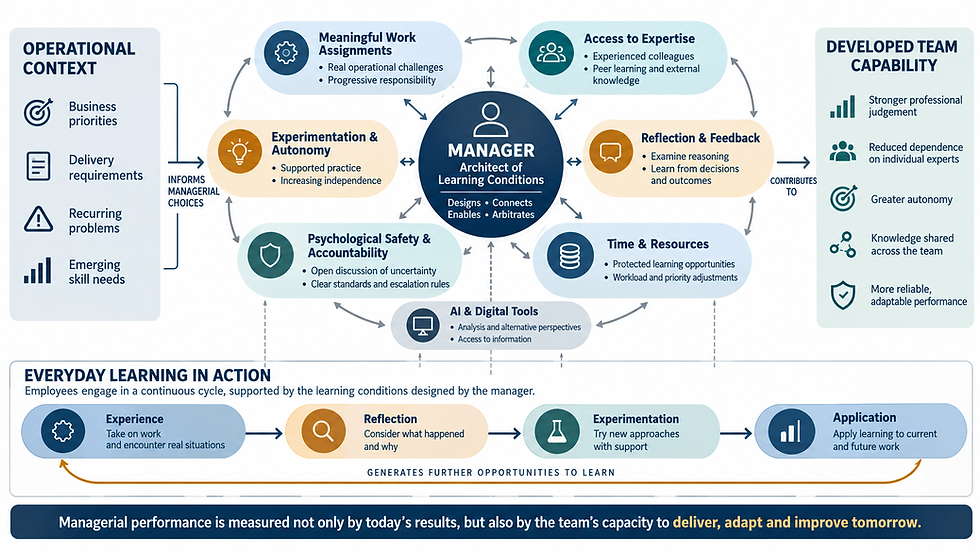
Recognizing the need to learn is not enough. Organizations must create conditions that allow experience to influence collective action. The work of Senge, Argyris and Weick and Sutcliffe points toward three connected requirements.
The first is to make operational experience visible. Performance reviews should examine not only whether planned actions have been completed, but also what unexpected difficulties have emerged, which assumptions have proved inaccurate, and what these discoveries imply.
The second is to make reasoning discussable. When managers disagree, the objective should not be to eliminate disagreement as quickly as possible. It should be to understand the evidence and assumptions underlying their different interpretations. This requirement is particularly demanding for senior executives. Their experience and past achievements have often reinforced assumptions about how organizations should be managed. These assumptions may have been entirely appropriate under the conditions in which they developed. Yet transformation can alter the circumstances that made them effective. An executive who has built a successful career through close operational control may find it difficult to adopt a genuinely decentralized management approach. More importantly, direct reports may have learned over many years that escalating decisions is safer than exercising independent judgment. When the executive subsequently calls for greater autonomy, these established behaviors may persist—not simply because managers resist change, but because they reflect the management environment in which they have learned to operate. The executive's own practices are therefore part of the organizational system that must evolve. When credible operational evidence challenges established assumptions, senior leaders have a particular responsibility to examine their reasoning rather than automatically attribute difficulties to others' execution. This does not mean abandoning authority, accepting every objection, or continually reopening strategic decisions. It means being willing to distinguish conclusions supported by evidence from assumptions that have become so familiar they are no longer questioned.
The third requirement is to translate new understanding into revised practices. If recurring problems reveal unclear decision rights, the organization may need to redefine them. If performance indicators encourage contradictory behaviors, they may need to change. If an established process no longer serves its purpose, the organization should reconsider it. Amy Edmondson's work on intelligent failure adds a practical dimension. Where uncertainty is genuine, carefully designed experiments can help organizations test new practices before deploying them extensively. Learning then becomes a disciplined activity rather than a retrospective justification for unsuccessful initiatives. Gary Hamel's work on adaptability reinforces the final implication: organizations cannot indefinitely rely on management arrangements designed for yesterday's environment while expecting to develop tomorrow's capabilities.
None of this means that every disagreement should reopen strategic decisions or that every difficulty requires organizational redesign. Effective learning also involves recognizing when the strategy is sound and execution simply needs improving. The challenge is to distinguish these situations through evidence and inquiry.
Learning as a condition for sustained transformation
Organizational transformation requires deliberate decisions, clear priorities, and disciplined execution. Learning is not a substitute for any of them. But execution alone cannot ensure success when the organization must develop capabilities, relationships, and ways of working that did not previously exist. This is why transformation and organizational learning must progress together. As change unfolds, organizations encounter new information about their customers, processes, management systems, and themselves. Whether this information becomes useful knowledge depends on their ability to interpret it collectively, question existing assumptions, and modify established practices. The responsibility of senior leadership is therefore broader than defining the desired future state and monitoring progress toward it. Executives are not external observers of the organization they seek to transform. Their decisions, assumptions, and behaviors contribute to the organizational system they are attempting to change. They must therefore create conditions in which operational experience can challenge established interpretations—including their own—and lead to better collective decisions. This is perhaps the most demanding aspect of organizational learning: recognizing that the assumptions which contributed to past success may not necessarily produce future success.
The ultimate test of transformation is not simply whether the organization has implemented what was planned. It is whether the organization has learned enough to operate successfully in the conditions that the transformation has created.
References
Argyris, C. (2010). Organizational Traps: Leadership, Culture, Organizational Design. Oxford University Press.
Edmondson, A. C. (2023). Right Kind of Wrong: The Science of Failing Well. Atria Books.
Hamel, G. (2012). What Matters Now. Jossey-Bass.
Senge, P. M. (2006). The Fifth Discipline: The Art & Practice of the Learning Organization. Doubleday.
Weick, K. E., & Sutcliffe, K. M. (2015). Managing the Unexpected: Sustained Performance in a Complex World. Wiley.


Comments